Mole or Melanoma? How to Check Your Skin
How to tell a normal mole from a possible melanoma using the ABCDE rule and the ugly duckling sign, how to check your skin at home, and when to see a dermatologist.
The short answer
A normal mole is usually small, symmetrical, evenly colored, and stays the same over time. A spot that is asymmetrical, has an irregular border, several colors, is wider than about 6 mm, or is changing, or that looks different from your other moles, could be melanoma and should be checked by a doctor or dermatologist promptly.
Key takeaways
- A typical harmless mole is small, round or oval, evenly colored, and stays the same over time.
- The ABCDE rule flags asymmetry, irregular borders, uneven color, a diameter over about 6 mm, and evolving spots.
- Change in a mole's size, shape, color, or height is one of the most important warning signs of melanoma.
- A mole that looks different from all your others, the ugly duckling, is worth showing a doctor.
- Some melanomas are pink, red, or skin colored, and some appear on the soles, palms, or under nails.
- A suspicious spot is diagnosed with a biopsy, usually a quick procedure in the doctor's office.
- Shade, protective clothing, broad-spectrum SPF 30 sunscreen, and avoiding tanning beds lower melanoma risk.
Most moles are harmless, and most adults have somewhere between a handful and a few dozen of them. Melanoma, the most serious common type of skin cancer, can start in an existing mole or appear as a new spot, and catching it early makes a large difference to how treatable it is.
This guide explains what normal moles look like, the warning signs dermatologists use, how to check your own skin, and when to book an appointment. It can help you decide which spots are worth showing a professional, but only an examination, and often a biopsy, can tell you whether a spot is cancer.
What is the difference between a mole and melanoma?
A mole is a harmless cluster of pigment cells, called melanocytes, while melanoma is a cancer that develops when those same cells start growing out of control. Because they come from the same cells, an early melanoma can look a lot like a mole, which is why the details matter.
According to the National Cancer Institute, a typical mole is smaller than about a quarter of an inch (roughly 6 mm), round or oval, with a smooth edge and an even color. It usually stays stable for years.
Melanoma tends to break those rules: it is often uneven in shape and color, and, most importantly, it changes. Skin changes of all kinds are part of everyday physical health, and new or changing spots are among the ones most worth a closer look.
What are the ABCDEs of melanoma?
The ABCDE rule is a simple checklist the American Academy of Dermatology (AAD) recommends for spotting moles that might be melanoma. A spot does not need all five signs to be worth checking; one is enough.
| Letter | Typical harmless mole | Possible warning sign |
|---|---|---|
| A: Asymmetry | Both halves match | One half looks different from the other |
| B: Border | Smooth, even edge | Ragged, notched, scalloped, or blurred edge |
| C: Color | One even shade of tan or brown | Several shades of brown or black, or patches of red, white, or blue |
| D: Diameter | Usually smaller than a pencil eraser | Larger than about 6 mm, though melanomas can be smaller |
| E: Evolving | Stays the same over months and years | Changing in size, shape, color, or height, or starting to itch, crust, or bleed |
Of the five, E is the one dermatologists often stress most. A mole that is changing deserves a check even if it passes every other letter.
What is the ugly duckling sign?
The ugly duckling sign means a mole that looks different from all your other moles. Most people's moles share a family resemblance, so a spot that stands out, whether darker, lighter, larger, or a different shape, is worth showing a doctor.
This sign helps with melanomas that do not follow the ABCDE pattern. It also works in reverse: if you have many larger or irregular moles that all look alike, a single small, smooth one that looks different can still be the ugly duckling.
What does early melanoma look like?
Early melanoma most often looks like a new dark spot or a mole that has started to change. It can be flat or slightly raised, and it is frequently brown or black with uneven coloring.
Not every melanoma fits that picture. According to the American Cancer Society and the AAD, some melanomas are pink, red, or skin colored (called amelanotic melanoma), some are firm raised bumps that grow quickly (nodular melanoma), and some appear in places you might not think to look.
Places that are easy to miss
- The scalp, the back of the neck, and behind the ears
- The back and the backs of the legs, which are common sites
- The palms, the soles of the feet, and between the toes, which are more common sites in people with darker skin
- Under a fingernail or toenail, where it can appear as a dark streak that widens over time
- Inside the mouth, the genitals, and the eye
Spots that are usually harmless
Many spots that worry people are something else. Seborrheic keratoses, which are waxy, "stuck on" brown growths common after middle age, freckles, and cherry angiomas, which are small bright red bumps, are all benign.
A small, red, itchy bump that appeared overnight is more often a bite, and identifying common bug bites can help you work out which, though any bump that lingers for weeks should be checked. A new patch of irritated skin may also be a rash, as covered in how to tell common rashes apart. If you are not sure, it is reasonable to have it checked.
Who is more likely to get melanoma?
Anyone can develop melanoma, including people with darker skin, but some factors raise the risk. According to NCI and the CDC, exposure to ultraviolet (UV) light from the sun and tanning beds is the main avoidable cause.
| Risk factor | Why it matters |
|---|---|
| Fair skin, light hair, or light eyes | Less natural protection from UV light |
| History of blistering sunburns | Especially sunburns in childhood or adolescence |
| Indoor tanning | Tanning beds expose skin to concentrated UV light |
| Many moles or unusual moles | Having a large number of moles, or atypical moles, raises risk |
| Personal or family history of melanoma | A close relative with melanoma increases your own risk |
| Weakened immune system | For example after an organ transplant |
Atypical moles, sometimes called dysplastic nevi, are moles that look unusual, often larger with irregular color or borders. Most never become cancer, but people who have several of them benefit from regular skin checks.
How do you check your skin for melanoma at home?
A monthly head-to-toe skin check in good light helps you learn what is normal for you so you can notice change. The AAD suggests using a full-length mirror and a hand mirror, or asking a partner to help with areas you cannot see.
- Stand in front of a full-length mirror and look at your face, chest, belly, and, for women, under the breasts.
- Raise your arms and check your underarms, both sides of your arms, your hands, palms, fingernails, and between your fingers.
- Turn and use a hand mirror to check your back, buttocks, and the backs of your legs.
- Sit down and check your legs, the soles of your feet, between your toes, and your toenails.
- Part your hair with a comb or use a hair dryer to check your scalp, and check your neck and ears.
Taking dated photos of moles you are watching, with a ruler or coin next to them for scale, makes it much easier to tell whether something has really changed. Do not try to remove or treat a mole yourself with creams, home remedies, or tools; as explained in our piece on apple cider vinegar and your skin, home treatments can burn the skin and delay a proper diagnosis.
What happens when a doctor checks a mole?
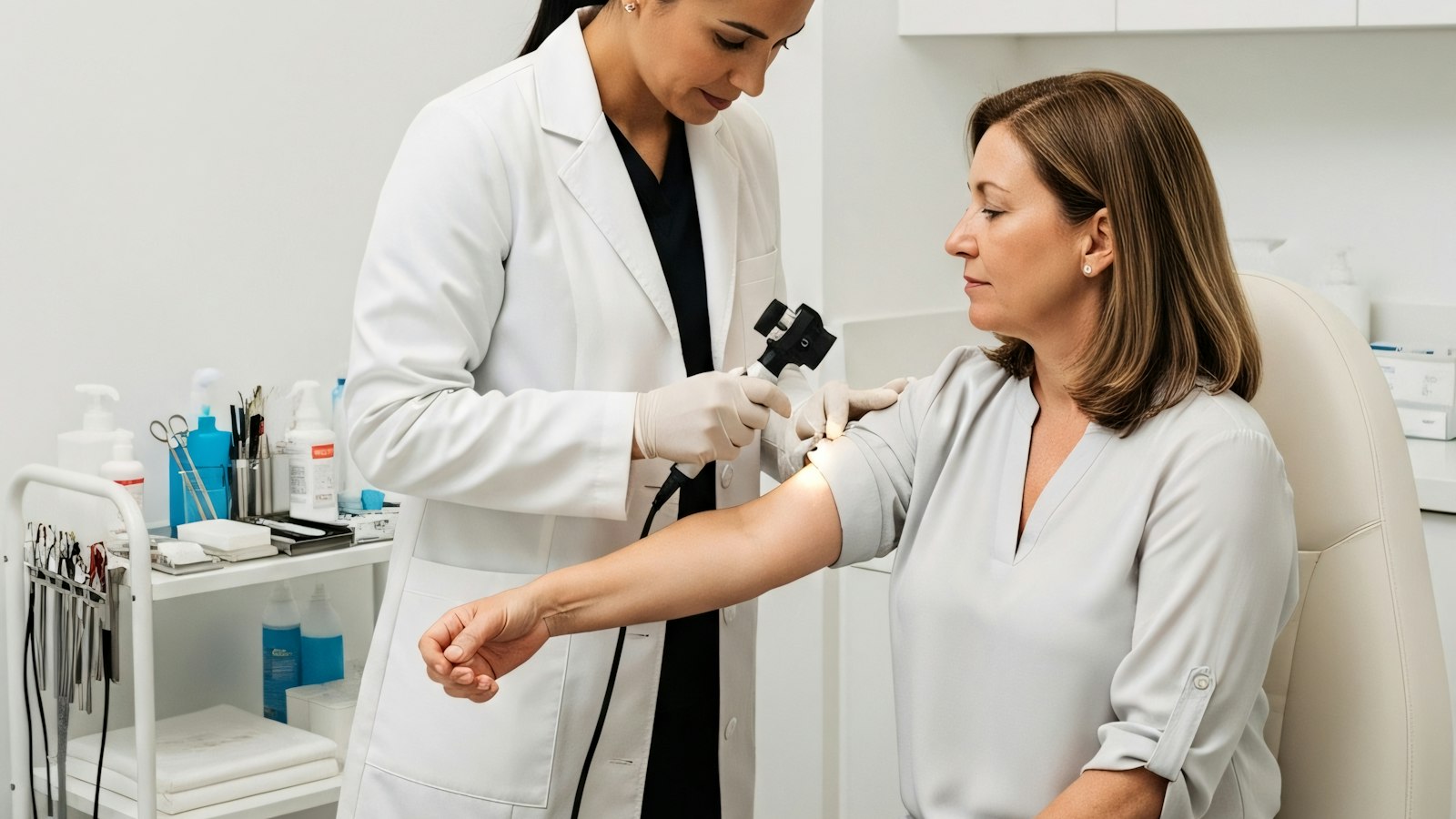
A doctor or dermatologist will look at the spot, often with a dermatoscope, a handheld magnifier with a light that shows patterns under the surface. They will also ask how long it has been there and whether it has changed.
If a spot looks suspicious, the usual next step is a biopsy, in which part or all of the spot is numbed and removed so it can be examined under a microscope. It is usually a quick office procedure.
When melanoma is found early, while it is thin and confined to the skin, treatment is often surgery to remove it with a margin of healthy skin, and the outlook is very good. According to NCI, melanoma that has spread is harder to treat, which is why early checks matter so much.
How can you lower your risk of melanoma?
Protecting your skin from UV light is the most effective step you can take. The CDC and the AAD recommend a combination of habits rather than relying on sunscreen alone.
- Seek shade, especially in the middle of the day when UV light is strongest.
- Wear clothing that covers your arms and legs, a wide-brimmed hat, and UV-blocking sunglasses.
- Use a broad-spectrum sunscreen with SPF 30 or higher on exposed skin, and reapply about every two hours and after swimming or sweating.
- Avoid tanning beds and sunlamps entirely.
- Take extra care with children, whose skin burns easily.
When should you see a doctor about a mole?
Make an appointment with your doctor or a dermatologist if you notice a new mole as an adult, a mole that is changing, a spot that shows any ABCDE sign, or an ugly duckling. Also see a doctor about a spot that itches, bleeds, crusts, or will not heal for several weeks, or a new dark streak under a nail.
Do not wait for your next routine visit if a spot is changing quickly, growing, or bleeding; call and ask for a sooner appointment. Your primary care provider can examine the spot and refer you to a dermatologist if needed.
A changing mole is not an emergency that needs 911. However, if you have been diagnosed with melanoma and develop new symptoms such as a seizure, sudden severe headache, confusion, or trouble breathing, call 911 or go to the emergency room.
If you have a personal or family history of melanoma, many moles, or atypical moles, ask your doctor how often you should have a professional skin exam.
Common questions
- How can I tell if a mole is cancerous?
- You cannot tell for certain by looking, but warning signs include asymmetry, a ragged border, several colors, a diameter over about 6 mm, and any change over time. A mole that looks different from your others is also a red flag. A doctor or dermatologist can examine it and, if needed, remove a sample for a biopsy.
- What does a cancerous mole look like?
- A cancerous mole often has uneven halves, a notched or blurred edge, and a mix of brown, black, red, white, or blue. It may be growing, raised, itchy, or bleeding. Some melanomas are pink or skin colored instead of dark, so any new or changing spot deserves a check, whatever its color.
- Is it normal to get new moles as an adult?
- New moles are common in childhood and young adulthood. A new mole appearing after about age 30 to 40 is less common and is worth showing a doctor, especially if it looks unusual or changes. Most turn out to be harmless, but new spots in adulthood are one of the ways melanoma can first appear.
- Should I worry if my mole is itchy?
- An occasional itch in a mole that otherwise looks unchanged is usually not serious and may come from dry skin or irritation. A mole that keeps itching, or that itches while also changing in size, shape, or color, or starts to crust or bleed, should be checked by a doctor promptly.
- Can melanoma be flat?
- Yes. Many melanomas start flat or only slightly raised, spreading across the skin before growing deeper. The most common type often looks like a flat or barely raised dark patch with uneven color and edges. Some types, such as nodular melanoma, are raised from the start and can grow quickly.
- How often should I check my skin for melanoma?
- The American Academy of Dermatology suggests checking your skin once a month so you learn what is normal for you. People with many moles, atypical moles, or a personal or family history of melanoma should also ask their doctor how often to have a professional skin exam.
- Can people with dark skin get melanoma?
- Yes. Melanoma is less common in people with darker skin, but it is often found later, when it is harder to treat. In people with darker skin it more often appears on the palms, soles of the feet, under the nails, or inside the mouth, so check those areas carefully.
Sources
Published research and guidance this page draws on. Check the original where a detail matters to you.
- 1Melanoma: MedlinePlus health topicMedlinePlus, U.S. National Library of Medicine
- 2Melanoma: MedlinePlus Medical EncyclopediaMedlinePlus, U.S. National Library of Medicine
- 3Moles: MedlinePlus health topicMedlinePlus, U.S. National Library of Medicine
- 4Common Moles, Dysplastic Nevi, and Risk of MelanomaNational Cancer Institute (NIH)
- 5What to look for: ABCDEs of melanomaAmerican Academy of Dermatology
- 6Melanoma: Signs and symptomsAmerican Academy of Dermatology
- 7Melanoma Treatment (PDQ), Patient VersionNational Cancer Institute (NIH)
- 8Skin Cancer: MedlinePlus health topicMedlinePlus, U.S. National Library of Medicine
This article is for general education and is not a substitute for professional medical advice. Speak with a qualified healthcare provider about your individual circumstances.
About HealthPathCore
An independent health knowledge library
Every article here is built from published research and guidance issued by named health bodies, written in plain language, and dated so you can see how current it is. When the evidence moves, we come back and correct the piece.
How we research and write